720, Fortune Business Hub, Science City Rd, Ahmedabad, Gujarat 380060
Buoyancy Software : Seamless IT Solutions, Delivered Every Time





We have successfully completed projects with dedication to the highest levels of customer satisfaction.

Paycheck analysis service to ensure accurate compensation.

Web logistics solution for streamlined shipping and tracking.

Web platform for marketplace management and business insights.

Web solution for legal professionals with powerful case management.

Web software for handling and optimizing business operations.

An IoT-powered smart home app for efficient climate and air quality automation.

Interactive city discovery experience for events and places.

SaaS platform that turns inventory spreadsheets into online resale storefronts.
Inspire trust and foster an ethical culture to thrive.
 Excellence
 Transparency & Integrity
 Innovation
 Collaboration
 Accountability


We partners with businesses to simplify technology, unlock innovation, and build secure, scalable solutions that support long-term success.

Launching a startup teaches lessons fast. In my first company, I believed a single brilliant coder would solve everything. Our first engineer shipped complex features at record speed but worked in isolation, left code undocumented, and unintentionally drained team morale. Progress slowed, trust wobbled, and we almost missed a key client demo. That experience changed how I hire. Early engineers do far more than write code. They set the pace of delivery, shape culture, and determine whether teammates feel proud to show up. If hiring feels exciting and overwhelming at once, here is a founder‑to‑founder playbook built from wins and mistakes. Use it to attract considerate builders, avoid common pitfalls, and create a calm, high‑output engineering team.
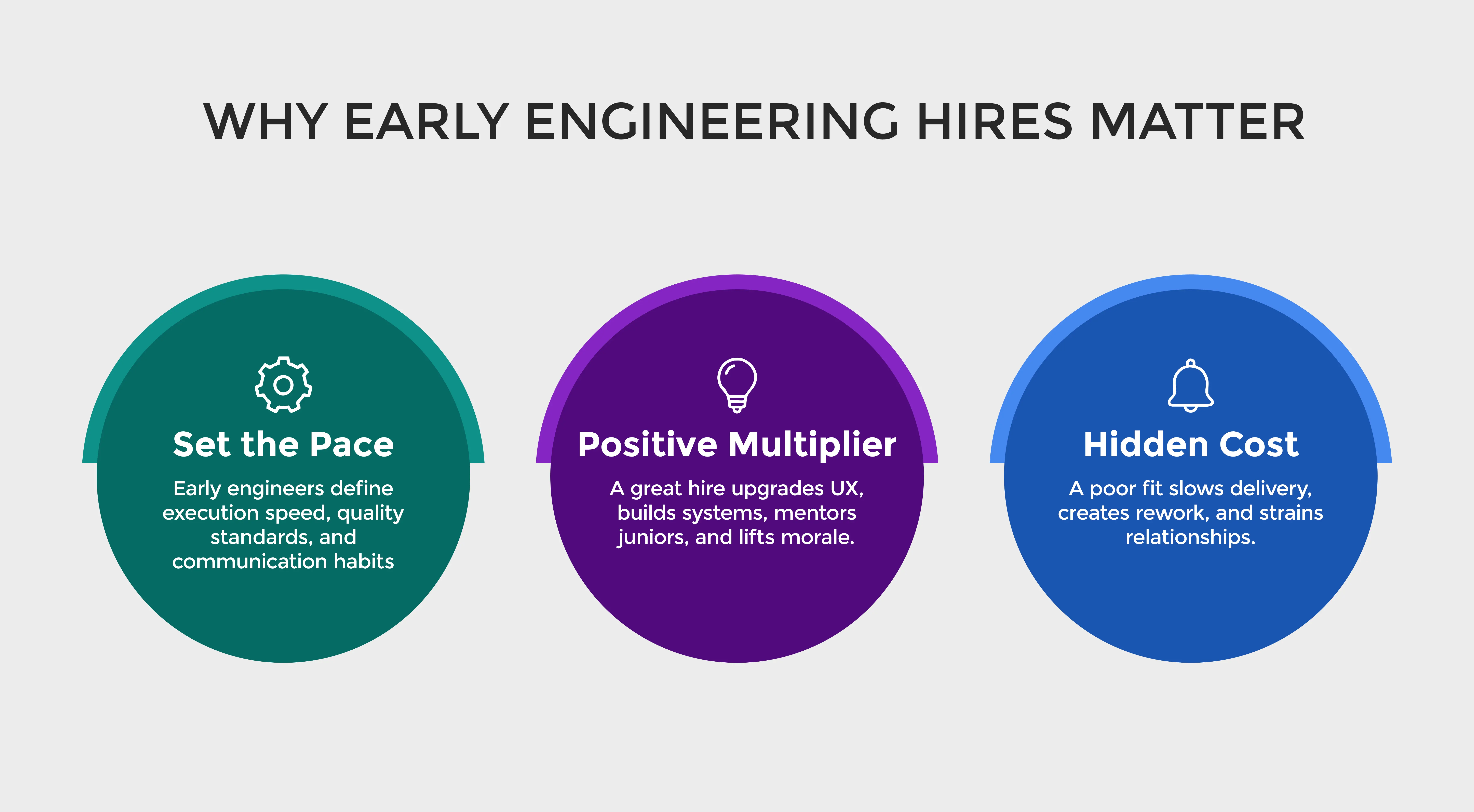
Candidates weigh stability against impact. Be honest about long hours, constraints, and ambiguity, then spotlight ownership, meaningful problems, and visible outcomes. Engineers who value impact over prestige will lean in when they hear a clear, credible mission.
A small brand can build trust through story. Publish what you are building, why it matters, and how you work. Share a short postmortem, a shipped feature, or a roadmap snippet. Authenticity beats polish
To protect equity and fairness, publish ranges and stick to them. When exceptions are necessary, document the rationale and apply consistently across similar roles.
Diverse teams build better products. Screen for shared values such as clarity, care for users, and accountability. Avoid cloning personalities. Diversity of background and thought improves decisions and reduces blind spots
Empathy, written clarity, async discipline, and conflict resolution turn chaos into cadence. Look for candidates who turn debates into decisions and critiques into coaching.
Use three tests:
Hire when the work is piling up but the team is not yet underwater.
Sample outline:
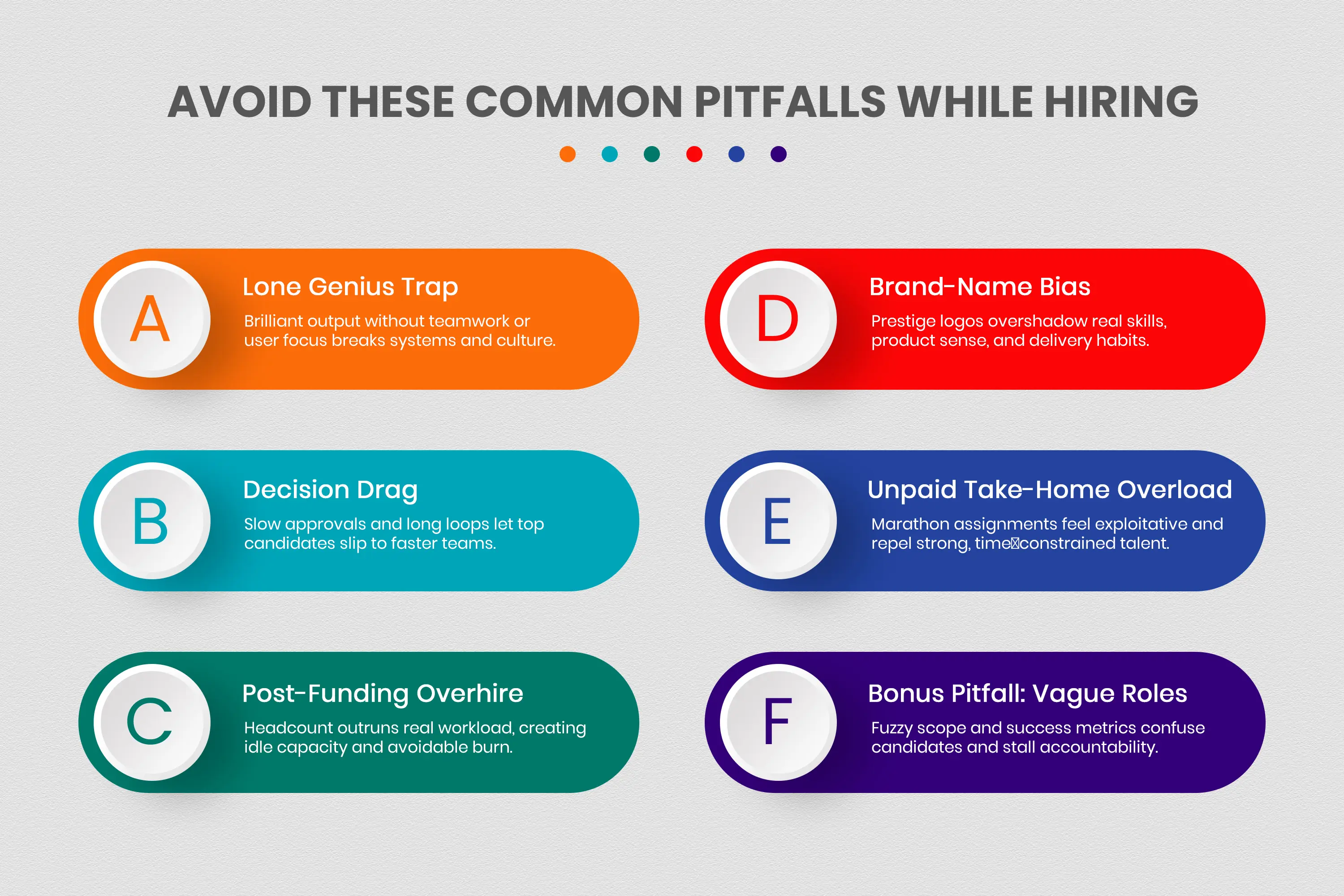
High-output soloists can look like a shortcut to velocity, yet they often create invisible debt that slows everyone later. When an engineer optimizes for personal speed without user empathy or team process, the result is fragile features, thin documentation, and brittle handoffs.
Red Flags: Sparse or outdated READMEs and runbooks, PRs merged with minimal review or context, features that "work on my machine" but fail in edge cases.
Fix It: Make docs, tests, and reviews non-negotiable acceptance criteria, tie performance to outcomes and collaboration, not lines of code, and pair a senior IC with a tech lead who owns standards and rituals.
Prestige resumes feel safe, but logos are a weak proxy for the skills your stage demands. Early startups need builders who can scope ambiguity, talk to users, and ship end-to-end. Overvaluing pedigree risks hiring for a past context that does not match your stack, customers, or constraints.
Red Flags: Interview debriefs that lean on "worked at X" instead of evidence, candidates ace trivia but struggle to reason about tradeoffs.
Fix It: Use work-sample tasks in your stack with clear rubrics, score "product sense," "communication," and "ownership" alongside technical depth, and calibrate reference calls to probe for ambiguity tolerance and follow-through.
Great candidates disappear while teams debate scheduling, case studies, or who else should "have a look." Slow cycles signal indecision and erode your reputation. In tight markets, velocity is part of your offer.
Red Flags: Multi-week gaps between stages, unclear decision owners for each step.
Fix It: Publish a 10-day funnel: Source → Screen → Task → Panel → Offer, pre-book interview slots and designate a final decision maker, and send same-day status updates to every candidate.
Long, unpaid projects feel exploitative and filter out the busiest high performers. They also create grading fatigue and bias.
Red Flags: Tasks exceeding 90 minutes or asking candidates to build production-grade features, high drop-off between assignment and submission.
Fix It: Replace with a 60–90 minute guided pairing session on a small, realistic slice, and if a take-home is essential, cap at 90 minutes and pay a stipend, and share feedback regardless of outcome to signal respect.
Fresh capital tempts teams to hire ahead of need. Idle capacity breeds make-work, diffuses accountability, and accelerates burn.
Red Flags: New roles without clear 90-day outcomes, "we'll find them something" as a justification.
Fix It: Tie each headcount to a quantified constraint: feature lead time, on-call load, backlog aging, gate offers behind a 30/60/90 plan with success metrics, and reassess hiring plan every quarter against revenue and roadmap reality.
Ambiguous scopes confuse candidates and stall performance after onboarding. People cannot win a game without a scoreboard.
Red Flags: JDs heavy on buzzwords, light on outcomes, new hires asking "what does success look like?" after week one.
Fix It: Write outcome-based JDs: "by day 90, own auth revamp with <200ms p95," publish responsibility boundaries using RACI for shared surfaces, and pair new hires with a buddy and weekly check-ins to de-risk ramp.
Document decisions, practice short focused sprints, keep releases predictable, and praise craftsmanship. Calm teams ship better software and retain great people.
Your first engineers are the roots of the product and the culture. Hire for values and ownership, tell a mission‑driven story, use a fair and fast process, and onboard with intention. This approach has helped our teams earn trust, reduce rework, and grow at a steady, sane pace. If you want templates for job descriptions, interview rubrics, and onboarding checklists, reach out and I will share the full toolkit. Build the team that builds the company.